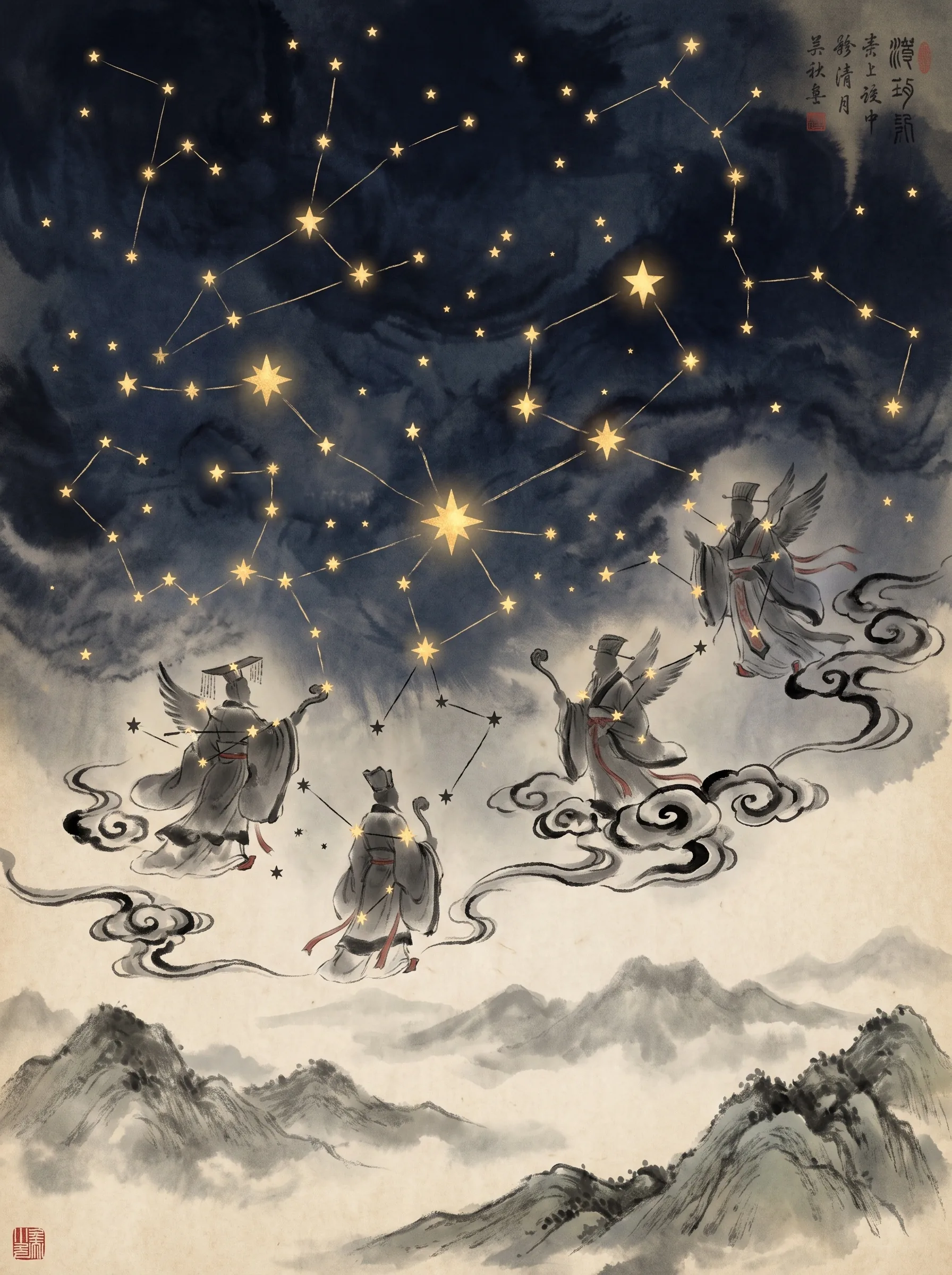
What the 14 Major Stars mean
A Zi Wei Dou Shu (Purple Star Astrology) chart distributes symbolic stars among Twelve Palaces. A Palace answers “which area of life are we examining?” while a Major Star suggests “how might this theme operate?” Tai Yang in the Career Palace and Tai Yang in the Fortune Palace therefore do not produce identical conclusions.
The fourteen stars form two calculated sequences: six in the Zi Wei series and eight in the Tian Fu series. This is neither a ranking from best to worst nor a zodiac of fourteen personality signs. A Palace may contain one or two Major Stars, while some have none and are read through the opposite Palace and the wider set of connected Palaces.
The Zi Wei series: six leading roles
The first series is positioned from Zi Wei. Treat the descriptions below as opening questions, not completed judgements about a person.
紫微 · Zi Wei
Coordination and responsibility. This role gathers a system around a centre, sets direction and maintains standards. Assistants, Palace and connections show whether it has practical support.
天機 · Tian Ji
Strategy and change. Tian Ji relates to analysis, options, movement and adaptation. Its useful question is how a plan is revised, not whether one symbol proves intelligence.
太陽 · Tai Yang
Visibility and contribution. Tai Yang describes outward expression, participation, guidance and the sharing of resources. Brightness and Palace refine how sustainable that activity feels.
武曲 · Wu Qu
Execution and resources. Wu Qu emphasises discipline, measurable results, handling assets and direct action. It does not promise wealth; it describes a practical mode of responsibility.
天同 · Tian Tong
Harmony and ease. Tian Tong relates to restoration, human connection and a less confrontational path. Under strain, the same role may raise questions about avoiding necessary effort.
廉貞 · Lian Zhen
Boundaries and intensity. Lian Zhen joins principles, rules, desire and deep involvement. It is especially sensitive to neighbouring stars: the pattern may support discipline or amplify struggle.
The Tian Fu series: eight ways of operating
The second sequence is positioned from Tian Fu. It complements the first group and occupies the same network of Twelve Palaces.
天府 · Tian Fu
Stewardship and preservation. Tian Fu describes holding resources, building stable support and keeping a reserve. Context shows whether caution is useful or has become inertia.
太陰 · Tai Yin
Inward observation. Tai Yin relates to receptivity, detail, planning and accumulation. It is a symbolic inward-facing mode, not a fixed statement about gender or destiny.
貪狼 · Tan Lang
Desire and exploration. Tan Lang points to novelty, social expression and expanding experience. Nearby factors help distinguish lively curiosity from scattered attention.
巨門 · Ju Men
Questions and argument. Ju Men emphasises speech, investigation, doubt and the exposure of hidden contradictions. In one context this is precise analysis; in another, difficulty reaching agreement.
天相 · Tian Xiang
Mediation and standards. Tian Xiang relates to diplomacy, reliable support and quality of execution. It is not necessarily passive; the role often involves active coordination between interests.
天梁 · Tian Liang
Protection and guidance. Tian Liang brings principles, care, experience and the restoration of a fair framework. When overextended, the same role can sound distant or overly instructive.
七殺 · Qi Sha
Decisions under pressure. Qi Sha describes independence, sharp choices and action amid uncertainty. It is not proof of inevitable danger and does not justify ignoring consequences.
破軍 · Po Jun
Dismantling and renewal. Po Jun relates to ending an outdated form, experimentation and rebuilding. Palace and support show whether change becomes considered renewal or costly haste.
What changes the meaning of the same star
| Layer | What it refines | Why the star alone is incomplete |
|---|---|---|
| Palace | The life area: identity, career, relationships, resources or another domain | The same role performs a different task in each Palace |
| Pairing | How two Major Stars share initiative and constraints | A companion may soften, accelerate or redirect a quality |
| Brightness | How readily a function can be expressed in that Earthly Branch | A weaker condition changes effort and circumstances; it does not erase the star |
| Supporting and challenging Stars | Resources, friction and methods of expression | A Major Star never acts in an empty environment |
| Four Transformations | Emphasis on prosperity, authority, recognition or obstacle | A Transformation directs the star’s function toward a specific theme |
| Connected Palaces | The opposite and two related Palaces | They connect a local symbol to the chart’s larger structure |
| Timing | How a natal theme becomes more visible in a temporary layer | Activation is not a guaranteed event |
Wu Qu, for example, describes practical handling of resources. In the Wealth Palace the question concerns money management; in the Career Palace it concerns execution and responsibility; in the Spouse Palace it concerns how practicality and control enter agreements. None of those readings comes from the star name alone.
A practical order for reading Major Stars
Find the relevant Palace
Begin with one specific question and identify its life area. If the structure is unfamiliar, use the Twelve Palaces guide first.
Record the Major Star or pair
Name the basic functions without judging them as good or bad. If no Major Star appears, review the opposite Palace and the borrowing rule.
Add brightness and the surrounding cast
Review the star’s condition, supporting factors and sources of friction. Note what helps the function and what requires additional effort.
Review Four Transformations and connections
Check Lu, Quan, Ke and Ji, then gather the opposite and two related Palaces. This is where a list of symbols becomes a contextual reading.
Separate the natal chart from timing
The natal chart remains the foundation. A 10-year Life Period or annual overlay adds a temporary emphasis; it does not rewrite identity or schedule an event.
Translate symbols into a useful question
Form an observation that can be checked: where support is needed, what should be discussed, which habit deserves review and what facts to collect before deciding.
Four common beginner mistakes
- Turning one star into a personality type. Even a star in the Life Palace is read with the Body Palace, connected sectors and its complete environment.
- Fearing a literal translation. Names such as Seven Killings or Army Breaker are traditional images of functions, not announcements of violence or misfortune.
- Treating brightness as a grade for the person. Brightness describes conditions of expression, not someone’s value, morality or total ability.
- Converting activation into an event. A star and a period can organise attention, but they do not guarantee a relationship, income, promotion, diagnosis or loss.
Sources and scope of this guide
The star list and its two calculated series were checked against Green Jade’s calculation model, the classical Complete Book of Zi Wei Dou Shu and the reference list of the fourteen principal luminaries. The role descriptions are written for a first reading and do not replace full combination rules across different schools.
Romanisation and translations vary. 巨門 may appear as Ju Men or Giant Gate, while 破軍 may appear as Po Jun or Army Breaker. The Chinese character is therefore a more reliable identifier than a translated nickname.
Common questions
Which of the fourteen stars is most important?
Zi Wei anchors the placement calculation for its series, but interpretive importance depends on the question, Palace and full configuration. There is no universally best star.
If the Life Palace has two stars, which one leads?
Both form a combination. Read their functions together, then use brightness, Supporting Stars, Four Transformations and connected Palaces to see the emphasis.
What if a Palace has no Major Star?
A Palace without a Major Star is not a missing life area. Traditional reading uses the opposite Palace, Supporting Stars and the connected-Palace structure.
Can one star identify a suitable career?
No. A career question needs at least the Career, Life and resource-related Palaces, their connections, the current period and the person’s actual skills and circumstances.