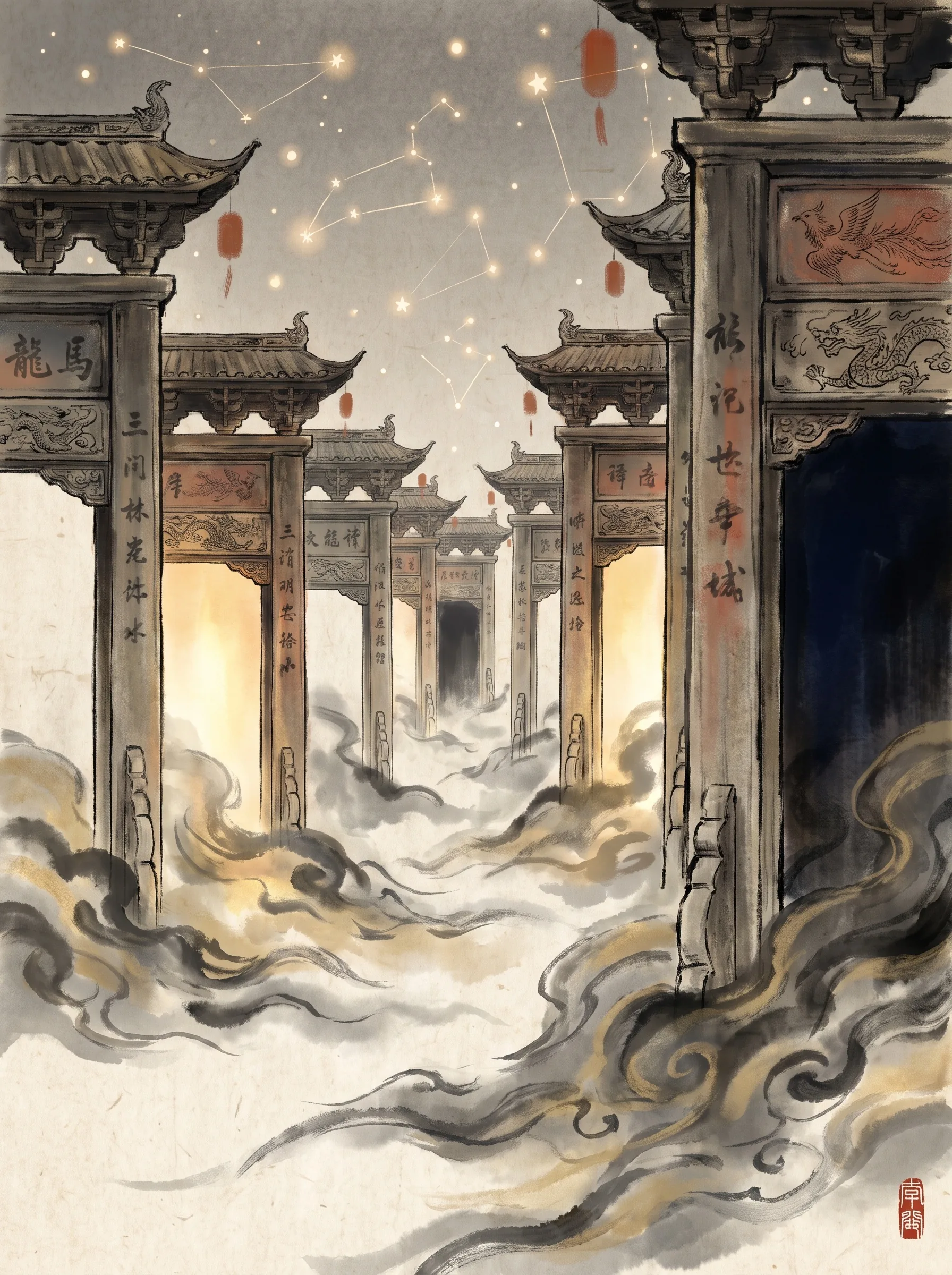
What the Eight Gates represent
八門 are calculated symbols of the human layer. They organise modes of action: negotiation, growth, pressure, concealment, presentation, completion, alarm or formal opening. Their positions move through the Nine Palaces according to the chart moment.
The traditional auspicious-neutral-difficult grouping is only an orientation. Harm may fit competition or repair; Rest may be too slow for an urgent launch. Suitability follows the task.
Meanings of the Eight Gates
休門 · Rest
Pause, recovery, calm discussion, study and support. Useful for reducing pressure; sometimes too slow.
生門 · Life
Growth, resources, production and practical development. It does not guarantee profit; capacity and Palace strength matter.
傷門 · Harm
Competition, intervention, correction and risk of damage. It can support forceful work while demanding safety.
杜門 · Delusion
Closure, secrecy, protection and restricted access. Useful for confidentiality, difficult for publicity.
景門 · Scenery
Visibility, documents, image, presentation and information. Strong display does not prove strong substance.
死門 · Death
Completion, stopping, removal and exhausted processes. The name does not predict death.
驚門 · Fear
Alarm, surprise, dispute and a danger signal. It highlights shock without proving a feared outcome.
開門 · Open
Access, official steps, career, agreements and public action. Check the Palace and Stems before proceeding.
Why a Gate is not enough
Identify the 用神 Palace for the asker, objective, other party or action. Then examine its phase, Void 空亡, Tomb 入墓 and relationship with the outcome Palace. Star describes process quality, Deity the mode of interaction, and Heaven and Earth Stems the manifestation and foundation.
Agreement across layers strengthens an interpretation. Contradiction calls for conditions and alternatives, not selecting the most convenient symbol. A Gate's home Palace is background; its actual Palace in this chart supplies the current environment.
A practical reading order
Define one action
State what will be done and what observable result matters.
Locate 用神
Do not begin with the brightest Gate if it is unrelated to the participants.
Name the function
Translate it into a neutral verb: open, restore, grow, limit, show or finish.
Add every layer
Check Star, Deity, Stems, phase, Void and Palace relationships.
State conditions
Describe the scenario, risk, safe step and evidence that would change the view.
Common mistakes
- treating an auspicious Gate as guaranteed success;
- reading Harm or Death literally;
- ignoring the original question;
- ignoring Void, Tomb and Palace relations;
- using one universal “lucky direction”;
- replacing an evidence-based plan with a symbol.
The Eight Gates cannot guarantee money, health, victory, an agreement or another event.
Frequently asked questions
Which Gates are auspicious?
Open, Rest and Life form the traditional three, but fitness depends on the task and complete structure.
Does Death Gate mean death?
No. It is a completion function, not a diagnosis or literal forecast.
Can direction be chosen from a Gate alone?
No. Use the relevant Palace, other layers and real-world safety.